Audition Log Book Template: A Practical Tool for Tracking Your Performance Journey
If you have ever prepared for an audition, you know how quickly the details blur from one casting to the next. Names, dates, sides, callback notes—keeping everything straight requires a consistent system. An Audition Log Book Template offers a structured way to record, review, and learn from each audition experience. Whether you are an actor, musician, dancer, or voice artist, this resource can help you turn each tryout into a data point for growth. This article walks through what these templates are, why they matter, and how to evaluate whether one suits your needs—especially if you are considering it as a product for Amazon KDP or as a personal tool.
What Is an Audition Log Book Template?
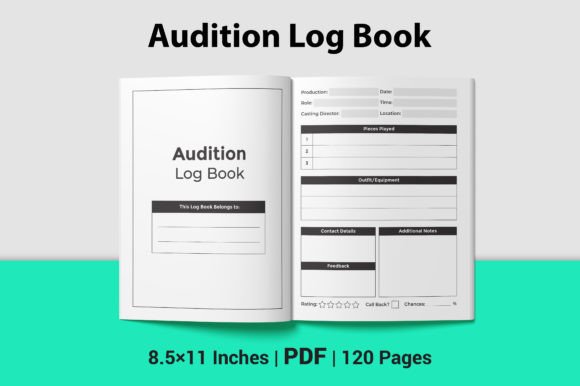
An audition log book template is a pre-designed document that organizes key information for every audition you attend. Typically formatted as a printable or fillable form, it includes fields such as:
- Date and time of the audition
- Project title and type (film, theater, commercial, voiceover, etc.)
- Role or character name
- Casting director, director, and producer names
- Sides or material used
- Notes on your performance, feedback received, and outcomes
- Follow-up actions (thank-you notes, agent updates, etc.)
For creators on Amazon KDP, an Audition Log Book Interior is a ready-made layout that can be uploaded directly to the platform. The product details often specify dimensions of 8.5 × 11 inches, page counts ranging from 100 to 120 pages, no bleed settings, and high-resolution print-ready files in PDF, AI, EPS, and JPG formats. The interior is precisely the content you need to build the inside pages of a paperback—you arrange your own cover separately.
The value of such a template lies in its consistency. Instead of inventing a new tracking method each time, you reuse a familiar structure. Over time, this repetition builds a habit of reflection and helps you identify patterns in your audition results.
Why Consider an Audition Log Book Template?
People explore audition log book templates for several reasons, and understanding these motivations can clarify whether this tool aligns with your goals.
- Organization for busy performers. The entertainment industry demands quick turnarounds. A template ensures you never forget important contacts or miss a follow-up.
- Tracking progress over time. Reviewing old entries can reveal strengths, recurring challenges, or shifts in the types of roles you book.
- Professional development. Reflecting on each audition privately can be more effective than relying on memory alone.
- Preparing for agent or manager meetings. A log book provides concrete data about your recent activity and success rates.
- Creating a product for others. If you are an entrepreneur or designer, selling an audition log book on KDP reaches a niche audience actively searching for this specific resource.
For each reason, the template itself is just a starting point. What matters is how consistently you use it and how well it adapts to your particular workflow.
Benefits
- Ready to use immediately. No need to design your own layout or decide which fields matter most. The work is already done.
- Consistent format. Each entry follows the same structure, making comparisons across auditions easier.
- Printable and portable. A physical book is reliable—no battery, no data loss, no distraction. Many performers prefer analog tools during a high-stress process.
- KDP-friendly specification. When you buy a template for self-publishing, the dimensions (8.5 × 11 inches), no-bleed interior, and high-resolution files match Amazon’s guidelines exactly. This reduces setup friction.
Tradeoffs
- One-size-fits-all layout. A template might include fields you never use (or omit fields you need). Customization is limited unless you edit the source file.
- Physical maintenance. Paper logs require storage and can be lost or damaged. Digital alternatives may offer better backup and search functionality.
- Time investment in reviewing. A log book only helps if you take time to reread and analyze past entries. Without regular review, the data becomes inert.
- Potential oversimplification. Auditions are complex experiences. A simple form may not capture nuanced feedback or emotional context.
Evaluating these tradeoffs helps you decide whether a printed audition log book template matches your habits and environment.
Key Features to Evaluate When Choosing an Audition Log Book Template
Whether you plan to use the template yourself or prepare it for KDP, a few design elements directly affect its usability and appeal.
- Page count and capacity. A 100-page book with one audition per page holds about 100 entries. A 120-page book extends that capacity. Consider how many auditions you attend per year and how often you expect to replace the log.
- Layout density. Some interiors offer generous spacing with large text fields; others pack in more fields for detailed note-taking. Choose based on your typical handwriting size and note length.
- Included sections. Does the template include a yearly overview, a contact list, or a goal-setting page? Additional sections can increase value but add complexity.
- File formats. PDF is essential for KDP upload, but having AI or EPS files allows you to make adjustments in vector editing software. JPG previews can help with cover design alignment.
- Bleed settings. No bleed means the interior is designed for trimming exactly to 8.5 × 11 inches, simplifying the upload process.
- Resolution and print readiness. High-resolution interiors (300 DPI or higher) ensure clean lines and legible text when printed.
Each of these features influences how well the template fits your purpose. Before committing, compare several options to see which layout aligns with your note-taking style.
When Is an Audition Log Book Template a Strong Fit?
There are scenarios where this tool provides clear advantages over alternatives.
- You are early in your performing career. Building the habit of recording auditions can accelerate learning and help you understand the industry faster.
- You prefer structured, repeatable processes. If you thrive on checklists and forms, a log book template will feel natural and supportive.
- You want to limit screen time. Auditions already involve plenty of digital communication. Keeping a physical log offers a break from screens.
- You are self-publishing on KDP and need a niche product. An audition log book is a specific demand from a well-defined audience. The interior files are ready to upload, which saves production time.
- You collaborate with a coach or mentor. A consistent log book makes it easier to share your experience with someone who can offer guidance.
In these situations, the template acts as a reliable scaffold for your professional practice.
When Might Alternatives Be Worth Considering?
No single tool works for everyone. Here are circumstances where a different approach may serve you better.
- You already use a digital calendar or CRM. Many performers integrate audition tracking into apps like Notion, Airtable, or specialized casting software. Digital systems offer search, tagging, and sharing features impossible in print.
- You need high customization. If you want to track unique metrics (e.g., self-tape lighting setup, reader feedback, emotional state), a blank notebook or a custom spreadsheet may be more flexible.
- You audition infrequently. For someone who auditions only a few times a year, a full log book may feel excessive. A single-page tracker or even a simple folder might suffice.
- You prefer minimalism. Carrying an extra 8.5 × 11 book may conflict with a lightweight on-the-go kit. A small pocket journal or digital note could be less bulky.
- You are designing for a very specific niche. For example, if you are creating a log book exclusively for child performers or voiceover artists, the fields in a general template may not capture relevant details.
Weighting these factors against your priorities will help you decide if a printed template is the best route.
Practical Decision-Making Insights
When you evaluate an audition log book template, take a step back and consider your overall tracking goals. Start by listing the types of information you most often need to recall after an audition. Common examples include the casting director’s name, the feedback you received, and the date you sent a follow-up. Compare that list against the fields in a template. If the template covers at least 80 percent of your needs, it is likely a time-saver. If there is a large mismatch, you may be better served by designing your own layout or adapting a general-purpose notebook.
For those self-publishing on KDP, the template offers a straightforward path to market. The no-bleed 8.5 × 11 interior, 100 to 120 pages, and high-resolution PDF files meet Amazon’s technical requirements. Remember that you must create your own cover separately. The quality of your cover will influence first impressions, so invest time there even if the interior is solid.
Another practical consideration: test the template yourself before finalizing a publication. Print a few pages, fill them out for a week’s worth of auditions, and see if the layout feels intuitive. Does it encourage reflection or feel tedious? Does it guide you to useful insights? Your own experience is the best indicator of whether the design serves its purpose.
Finally, think about long-term use. A single log book might last six months to a year depending on audition frequency. Consider if you are willing to buy or print another copy when the first one is full. If the answer is yes, the template is likely a helpful investment. If you rarely finish notebooks, a digital alternative may keep your habit alive.
An Audition Log Book Template is not a magical solution, but it is a practical tool that can bring clarity and structure to an often chaotic process. By understanding what the template offers, where it excels, and when another option might work better, you can make an informed decision that supports your development as a performer or your goals as a publisher.