Lined Notes Kdp Interior: A Smart Foundation for Your Publishing Workflow
If you’ve spent any time exploring print-on-demand or self-publishing on Amazon KDP, you already know that the right interior file can make the difference between a product that sits idle and one that moves consistently. Lined Notes Kdp Interior is exactly that kind of asset—a thoughtfully designed, fully editable template built to streamline your production process. It’s not a fancy concept or a gimmick. It’s a straightforward, reliable tool for anyone who wants to publish journals, diaries, or notebooks without reinventing the wheel every time.
I’ve worked on this type of content for years, helping creators, small business owners, and educators bring their ideas to print. What I appreciate about this particular interior is its focus on what actually matters: clean structure, easy customization, and real-world performance. Let’s walk through what makes it tick and how you can put it to work.
What This Interior Actually Offers
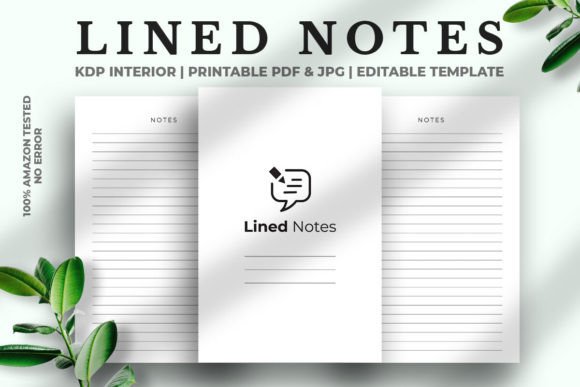
At first glance, Lined Notes Kdp Interior looks like a simple lined page layout. But dig a little deeper, and you’ll find a set of features that solve common headaches for anyone who publishes low-content or no-content books. The file comes in 6 x 9 inches—a popular size that fits neatly into the journal and notebook niche on Amazon. You get 120 pages with no bleed, which means you don’t have to worry about trimming or layout adjustments when uploading to KDP.
The real standout here is the vector editable PDF. You can open it in Adobe Illustrator and resize, recolor, or restructure elements without losing any quality. That’s a huge time-saver if you want to tweak line spacing, add headers, or integrate your own branding. Alongside the PDF, there’s a high-resolution JPG at 300 DPI, useful for previews, marketing materials, or quick mockups. The entire design is original, tested on Amazon KDP with no validation errors, and ready to upload as-is.
Vector Editing: More Than Just a Buzzword
Why does a vector editable PDF matter for a lined journal? Because it gives you control. Suppose you want to change the line color from standard gray to a soft pastel to match a cover theme. Or maybe you need to adjust the margin width so the binding doesn’t eat into the writing area. With a vector file, those changes take seconds. You aren’t locked into a static design. This flexibility is especially valuable if you’re planning to publish a series of notebooks with different themes, sizes, or target audiences. One source file can become a dozen distinct products.
Real-World Applications Across Audiences
This interior isn’t just for one type of user. I’ve seen it work effectively in several scenarios, and each one highlights a different strength of the design.
For Independent Publishers and Entrepreneurs
If you’re building a KDP business around low-content books, consistency is key. Lined Notes Kdp Interior gives you a base that you can replicate across multiple titles. Publish a gratitude journal, a daily planner, a meeting notebook, and a travel diary—all using the same core layout but with different covers and minor interior tweaks. The 120-page count is a sweet spot: enough content to feel substantial, but not so many that printing costs eat into your margins. I’ve recommended this page count to clients who want to test new niches without overcommitting on production.
For Educators and Workshop Leaders
Teachers and trainers often need custom notebooks for courses or handouts. Maybe you want a workbook that includes lined pages for note-taking alongside prompts or instructions. Because the PDF is fully editable, you can insert section breaks, add question prompts, or adjust line spacing for younger students. I worked with a colleague who used this interior to create a set of reflection journals for a professional development workshop. She added custom headers and a table of contents, then uploaded directly to KDP for print-on-demand. No bulk ordering, no inventory risk.
For Creative Professionals and Freelancers
Designers, writers, and artists often use notebooks for brainstorming, sketching, or journaling. The clean, no-bleed layout of this interior supports both handwriting and light illustration. If you want to create a branded notebook to give to clients or sell on your website, the vector files make it easy to add your logo, contact information, or a custom cover inside the PDF. The high-resolution JPG is also handy for promoting the product on social media or your portfolio site.
For Hobbyists and Personal Use
Not everyone publishes to sell. Some people just want a well-made notebook for their own use. If you’ve ever struggled to find a journal with the exact line spacing or page count you prefer, this interior lets you make it yourself. You can print it at home, take it to a local print shop, or upload it to a print-on-demand service for a single copy. The vector file ensures that the printed result looks crisp, no matter the printer or paper quality.
Practical Benefits You’ll Notice Immediately
Let’s move beyond features and talk about what this interior actually does for you in daily use.
- Time efficiency: The file is pre-tested on KDP, which means no formatting errors, no bleed issues, no sudden surprises during upload. You can go from download to publish in a matter of minutes if you choose to use it as-is.
- Scalability: Because it’s vector-based, you can resize or adapt the interior for different trim sizes or formats. That saves you from starting from scratch every time you want to launch a new product.
- Brand consistency: Use the editable PDF to incorporate your brand colors, fonts, or stylistic touches. Over time, your customers will recognize your journals even without seeing the cover.
- Print confidence: The no-bleed design and high-resolution output mean you don’t have to second-guess how the final book will look. I’ve seen too many publishers waste time fixing margins or resolution issues. This interior sidesteps those problems entirely.
- Customer experience: A well-structured lined page is comfortable to write on. The 6 x 9 size fits nicely in a bag or on a desk, and 120 pages provide enough space for ongoing use without becoming bulky.
What to Look for When Choosing a Lined Interior
Not all interiors are created equal. Based on my experience in print production, here are a few practical considerations when evaluating a template like Lined Notes Kdp Interior.
- File format and editability: Make sure the PDF is truly vector-based and works with your design software. If you don’t use Adobe Illustrator, check whether it opens in alternative programs like Affinity Designer or Inkscape. The ability to edit without degradation is a major quality marker.
- Bleed settings: A no-bleed file simplifies upload and printing. However, if you plan to expand into different trim sizes, confirm whether the interior can be adapted or if it’s locked to one dimension.
- Page count flexibility: 120 pages works well for many projects, but you might need more or less depending on your niche. Since the file is editable, you can duplicate or delete pages as needed.
- Testing and error-checking: The claim “100% tested on Amazon KDP” is more valuable than it sounds. Even small validation errors can delay your listing or cause printing problems. A pre-tested file saves you that troubleshooting time.
- Resolution and print quality: 300 DPI is the standard for print. Anything lower can result in blurry lines or poor text legibility. This interior meets that benchmark, so you’re covered.
Realistic Use Cases to Inspire Your Next Project
Let’s put this into concrete terms. Imagine you’re a freelancer who wants to publish a line of minimalist notebooks for remote workers. You can take the Lined Notes Kdp Interior, adjust the line color to a soft blue that matches your brand palette, and add a discreet company logo at the bottom of each page. Title the notebook “Remote Work Daily Log,” pair it with a simple cover, and list it on KDP. The whole process, from concept to listing, can be done in an afternoon.
Or picture a small business owner who hosts monthly goal-setting workshops for local entrepreneurs. You could create a custom workbook that includes a few intro pages, followed by 100 lined pages for journaling. Print a handful of copies at a local shop or use KDP’s print-on-demand for participants who want extra copies. The vector file lets you update the workbook each quarter without redoing the layout.
Even for personal use, the practicality is clear. I’ve used similar interiors to make travel journals for trips where I wanted more control over the page layout than off-the-shelf notebooks offered. Adding a pocket for tickets at the back or changing the paper orientation was straightforward because the base file was fully editable.
Final Thoughts on Using This Interior
Lined Notes Kdp Interior is not a magic solution—it’s a well-built foundation. Its value comes from the combination of reliable formatting, editing flexibility, and real-world testing. Whether you’re publishing your first journal or expanding a catalog of hundreds, having a dependable interior file simplifies the technical side of the process so you can focus on content, branding, and marketing.
If you’re evaluating interiors, pay attention to the details that affect your workflow: vector editability, KDP validation, and print quality at scale. This interior checks those boxes while leaving room for creativity. And if you find yourself customizing it for different projects, that’s exactly the point. A good interior adapts to your needs, not the other way around.